
What people actually need from those who lead them and the skills to deliver it
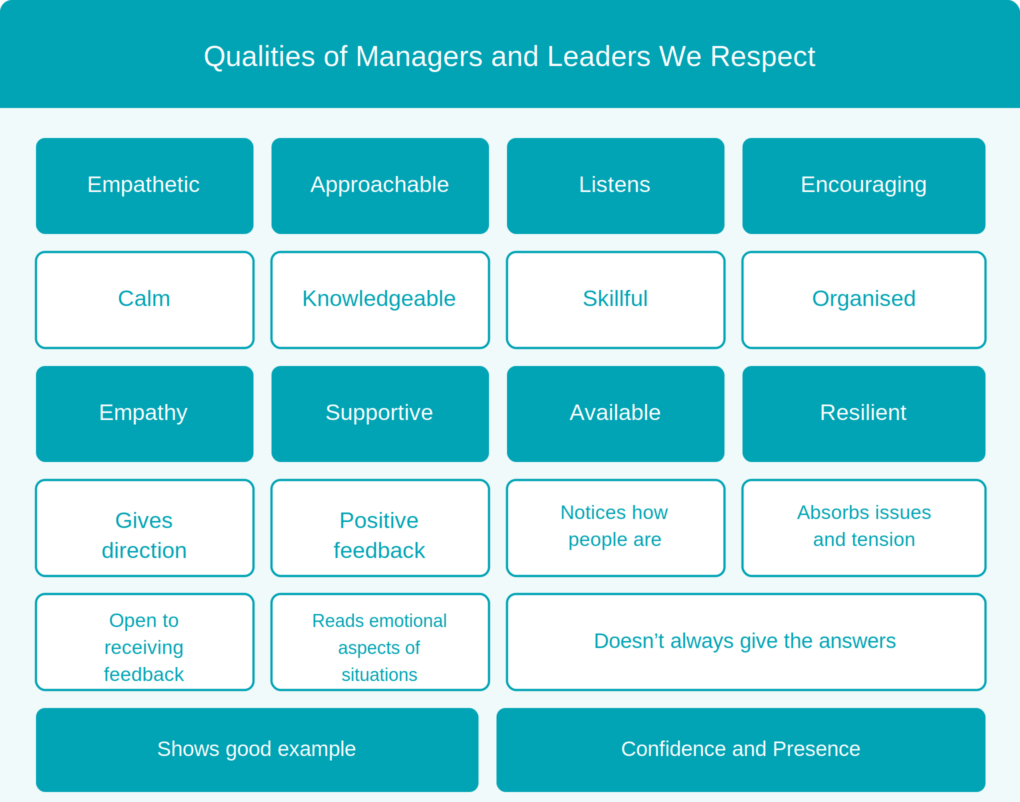
To frame a day of coaching skills for a group of senior leaders, I asked participants to think of a manager or leader they had genuinely respected and to write down the qualities that made them stand out. The image above captures what they came up with.
I couldn’t have framed it better myself.
This list captures what people actually need from those who lead them. Nobody wrote always has the answer or solves my problems for me. What they described was something more nuanced: a leader who could read the room and respond to what they found there, who held people accountable with warmth and created the conditions for their team to think and grow.
That is a significant set of capabilities and they matter more than ever.
This leads me to the topic of employee engagement, and the data tells a more complicated story than it first appears. Gallup’s most recent State of the Global Workplace report puts global engagement at 21%, a figure that generates alarming headlines. But as Steven Buck, Principal People Scientist at Workvivo, points out, other established researchers report engagement levels of 70% or more. The gap is not because one is wrong. It is because they are measuring different dimensions of the same thing. Emotional engagement looks very different from cognitive or behavioural engagement, and the picture is more complex than any single number can capture.
What is consistent across all of these perspectives, however, is this: the quality of leadership, and specifically the quality of the conversations that leadership generates, sits at the heart of the engagement question. The response in many organisations remains structural, with more process, more reporting and more frameworks being added. What is needed is something more fundamental.
Before exploring the how, it is worth being clear on the what. Sir John Whitmore, one of the pioneers of coaching in organisations, described its purpose as raising awareness, generating responsibility and building self-belief. It is a deceptively simple formulation. Awareness of what is actually happening, responsibility for what to do about it, and self-belief that you have what it takes to do it. At its heart, coaching is about creating the conditions for someone to access all three, not by providing the answers, but by asking the questions that help them find their own.
The tell-or-ask question
The familiar conversation I have with leaders working on their coaching conversation skills is that they recognise the internal push to tell and to problem-solve. Time is resoundingly a key factor, with the constant pressure of competing demands making a quick answer feel like the only practical option. And if they are honest, there is often a recognition of a desire to control: when we tell, we stay in control of the conversation. When we ask, we hand that control to someone else, and we have to trust that they will get somewhere worth going. That requires a different kind of confidence, not confidence in our own expertise, but confidence in the other person’s capability.
Of course, not every manager sits at the telling end of the spectrum. Some leaders are naturally more inclined to ask, to explore, to hold back their own view and create space for others. But even for them, the question is worth examining, because defaulting to inquiry without discernment has its own pitfalls, as I will come to later.
This is what the thinkers on organisational learning have been pointing to for decades. Chris Argyris and Donald Schön wrote about the gap between espoused theory, meaning what we say we believe, and theory-in-use, meaning what our behaviour actually reveals. Most managers say they believe in developing their people. But their instinct under pressure is to solve and direct, to close down the conversation rather than open it up. The gap between the two is where much of leadership development actually lives.
Peter Senge built on this in The Fifth Discipline, exploring how our mental models, the assumptions and generalisations that shape how we see the world, operate below the level of conscious awareness. We see a problem, interpret it through our existing understanding, and reach for the solution that has worked before. All without noticing that we are doing it. The result, at a team level, is what Senge called single-loop learning: fixing the problem in front of us without ever questioning the assumptions that created it.
Double-loop learning, the kind that genuinely develops people and organisations, requires inquiry. It requires someone to ask not just what happened but what led us to think the way we did? Not just what should we do but what are we assuming here? That kind of question takes a different quality of attention.
The balance of advocacy and inquiry
This is the tension at the heart of leadership communication: the balance between advocacy and inquiry. Advocacy is stating your views, your reasoning, your conclusions. Inquiry is genuinely exploring someone else’s thinking, not to confirm what you already believe, but to understand what they know, feel and see that you might not.
Both matter. Neither is always right. But most managers are significantly better at one than the other. In my experience of organisations where a leadership change has resulted in a move toward a more directive style, the impact is visible and consistent, on wellbeing and engagement and ultimately on productivity. People feel directed rather than developed, managed rather than led. The directive and pacesetting styles that are perceived to drive results often create overwhelm over time, and it is overwhelm, more than any single event, that quietly erodes both engagement and performance.
Advocacy is also reinforced by something less visible: the story we tell ourselves about what is happening, formed so quickly and held so firmly that we rarely stop to question it. When a manager brings that story into a performance conversation without examining it, what follows is rarely a conversation at all. It is an announcement. The other person either accepts it or defends against it. Neither produces the insight or the ownership that genuine development requires.
What inquiry actually requires
Shifting the balance toward inquiry is not simply a matter of asking more questions. It requires a quality of attention that many leaders have never been explicitly taught.
Listening is the foundation. Most of us listen in order to respond. We are composing our reply while the other person is still speaking, or we are waiting for the point we recognise so we can confirm what we already thought. Deep listening means suspending that process. It means attending not just to the words but to what sits beneath them, what is felt but not yet said. It means tolerating silence long enough for the other person to find their own way to what they actually think.
Questioning is the visible expression of inquiry, but the quality of a question depends entirely on the curiosity behind it. A question asked in order to lead someone to a predetermined answer is advocacy in disguise. A genuinely curious question, one that opens rather than directs, can shift the entire quality of a conversation. It signals something important: I believe you have something worth finding here. I am not going to find it for you.
Self-awareness is what makes both of these possible. Without it, a manager cannot know their own default patterns, whether they move too quickly to advice, whether they coach when they should direct, whether they mistake activity for impact. The qualities people listed in that exercise, reading emotional aspects of situations and noticing how people are, are expressions of self-awareness in practice. So is resilience: not imperviousness to difficulty, but staying regulated enough under pressure to remain genuinely present for the people you lead.
The coaching conversation
At its best, a coaching conversation creates the conditions for someone to solve their own problems. It builds resourcefulness that lasts, develops capability rather than dependency, and signals something important: I trust your ability to work this out.
This matters because of a simple truth. When we solve our own problems, we take more ownership of the outcome. When someone else solves them for us, even with the best of intentions, we are quietly deprived of the opportunity to develop genuine belief in our own capability.
But coaching is not always the right approach. If someone lacks the skills or knowledge to address a problem, asking them questions they cannot yet answer is frustrating and unfair. If something is time-critical, the moment for exploratory conversation has passed. If the stakes are low and the task is straightforward, a coaching conversation can feel disproportionate.
For leaders whose natural style leans toward inquiry, there is a different pitfall worth naming. The instinct to ask rather than tell is a genuine strength, but without discernment it can become its own kind of abdication. A client of mine described what this felt like from the other side. Every conversation with her manager had become a coaching session. Every problem she brought was met with a question. It was exhausting. Sometimes she just needed him to tell her what to do. The art is not in choosing between coaching and directing. It is in developing the awareness to know which serves the person and the situation in front of you, and the skill to move between them with confidence.
What effective leadership looks like
The qualities on that list are not a checklist. They portray the emotional impact of effective leadership which ultimately supports engagement and performance. What they point to is a manager who understands themselves well enough to choose their approach consciously; who reads others with genuine curiosity; who listens deeply and asks questions that open rather than close down thinking; who gives feedback that is honest and kind; who can flex between coaching and directing; and who stays resilient under pressure, not impervious to difficulty, but regulated enough to remain present and purposeful when things are hard.
These are learnable skills. And they are, perhaps, best described not by a framework or a model, but by a group of senior leaders with a blank sheet of paper and a question about the people who led them well.
Why this matters at an organisational level
In my experience, the gap between organisations where engagement is thriving and those where it is not is rarely primarily a structural one. Leadership capability, and specifically the quality of the conversations that leadership generates, is almost always at the centre of it. And developing coaching skills in managers is one of the most impactful investments an organisation can make, not because it makes managers nicer, but because it changes how teams experience being led, and that changes what teams are capable of.
When managers learn to balance advocacy and inquiry, they stop being the ceiling on their team’s potential. When they develop genuine listening and questioning skills, conversations at every level get better. When they build self-awareness about their own defaults, they become more consistent and more trustworthy. And when they develop the confidence to flex their style based on both the needs of the situation and the people, they become the kind of leaders that appear on other people’s lists.
If you’d like to explore what a coaching skills programme could look like in your organisation, we’d love to talk.
Frequently asked questions
What is the difference between a manager and a coach? A manager’s role involves directing and deciding, driving results through others. A coach’s role is to create the conditions for others to think clearly and find their own way forward. The most effective managers develop both capabilities and make a conscious choice about which serves the person and situation in front of them.
What is the difference between advocacy and inquiry in leadership? Advocacy is stating your views, reasoning and conclusions, essential for direction and clarity. Inquiry is genuinely exploring someone else’s thinking, essential for development, trust and better decisions. Many managers default heavily to advocacy, even when inquiry would serve them better. The work of Argyris and Senge on organisational learning has been foundational in understanding why this shift is so difficult and so important.
When should a manager use coaching rather than giving direction? Coaching is most powerful when the person has the capability to work through the challenge themselves but needs space and the right questions, with someone thinking alongside them. If someone lacks the skills or knowledge to address a problem, or if something is time-critical, a more direct approach is more appropriate. The art is in knowing the difference, and in not letting direction become the default.
How can organisations develop coaching skills in their managers? At KOI we work with organisations across Ireland and internationally to develop coaching skills in their managers and leaders, in person and virtually, in programmes that are practical, immediately applicable and grounded in real conversations. If you would like to explore what this could look like in your organisation, we would love to talk.
What Our Clients Say

"My team worked with Isolde and KOI for 6 years and the experience was transformative. Aligning goals, roles and teamwork is key to success, and Isolde will drive this alignment - especially for remote teams. Isolde can help you keep teamwork and connection."
Eric Bailey
Global Director of Travel, Venue Source and Payments, Microsoft.


"Working with Isolde transformed our leadership team. She helped us navigate major global change, build trust and reach a level of performance we hadn’t achieved before."
Brian Kirwan
Director Globalization & Development.


"The Advanced Leadership Development programme is our most recommended programme, year after year. KOI delivers real impact. Participants leave with greater self-awareness and skills they apply immediately. We re-commission it because it works."
Shauna Ennis
Head of Learning and Development, Tallaght University Hospital


"The Emerge programme exceeded our expectations in developing our female talent pipeline. Participants developed leadership skills across 16 areas and described the impact as transformational both personally and professionally."
Linda Allen
Head of Talent Management, Iarnród Éireann Irish Rail


"Isolde has guided the leadership development of our senior team over several years, always delivering meaningful results with professionalism and empathy. A genuinely positive impact on our organisation."
Allison Aldred
CEO, Good Shepherd Cork


"A key partner to PTSB, KOI delivers our Emerge Programme enabling the development of our future leaders, helping them build confidence, strengthen self-awareness, and define how they show up as leaders every day, while shaping a strong and values-led culture across the bank."
Louise Geraghty
Learning & Talent Manager, PTSB


"KOI, led by Isolde, delivered a focused leadership and organisational development project that supported Efund through a major restructuring. The programme left our team aligned, prepared, and ready to embrace our new structure - setting the path for sustainable growth."
Pierre Ponsar
CEO, Efund Group


"We've worked with Isolde for more than ten years. She understands our business and asks the questions we avoid asking ourselves. This has changed how we manage, communicate and make decisions. Today we lead with more empathy, and it shows in our culture.
"
Ann-Marie O'Neill
Founder and Creative Director, O'Donnell O'Neill