
How often do you lie in bed rerunning aspects of the day, or wake in the early hours with a busy mind, solving a problem or planning a conversation?
If that is familiar, you already know the truth this article rests on: switching off is not a holiday skill, it is a daily one, and the time off you are planning this summer is simply the biggest test of a skill you have either developed or you haven’t (yet!).
It’s one thing knowing what you should do. It’s another to have your mindset and nervous system aligned so you can switch off when you choose to.
Learning it the slow way
In my early thirties I tried yoga for the first time. I gave it up quickly because the teacher asked us to empty our minds. The idea of not using every minute to plan, organise and think was incomprehensible to me; I had no concept of either the purpose or the benefits.
I came back to yoga in my forties and completed a 200-hour yoga teacher training programme. Through it I discovered that yoga is ultimately about preparing the body for meditation. Savasana is my favourite pose, lying there at the end of practice with a totally quiet mind, the very thing that had once been beyond me. I could not have arrived there by deciding to.
Yoga is an example but not the whole story. Over the years, somatic and meditative practices have deepened the same capacity: being fully in the present moment. At thirty I could have told you rest mattered. What I did not have was the knowledge, support or practices to enable my nervous system to stand down.
What it looks like in practice
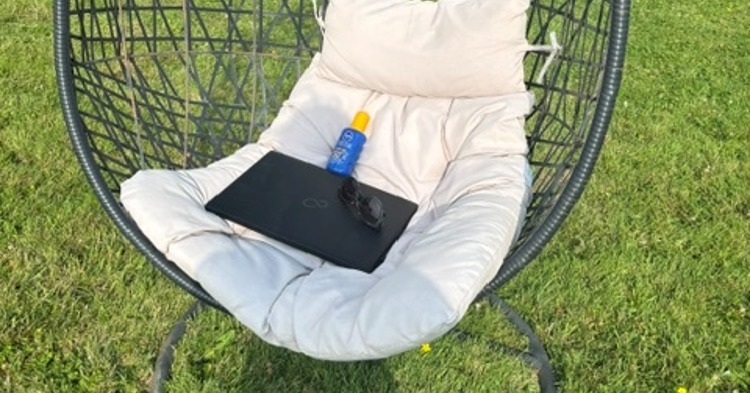
What does that capacity make possible? Last October is a good example. It was a busy time. Lots of work happening, lots of enquiries, the kind of momentum a small business owner is grateful for and reluctant to interrupt. The summer had been quiet, which is usual, and I had valued that time. Now the work was flowing and my clients needed me to be responsive. As I saw it, I had two options: cancel the holiday, or dedicate a set time to work each day. I chose the second, and it is not the first time I have made that choice.
I share this because I explore the benefits of switching off with the people I coach. However I recognise that it’s not always as simple as saying take a break. Anyone who has run a business or carried real responsibility knows that. The question is not whether you ever work on holiday. The question is whether the choice is intentional or compulsive.
From the outside, two leaders on holiday with laptops look identical. But one has made a considered decision: a ringfenced window, a clear purpose, and a laptop that genuinely closes when the time is up. The other is just keeping an eye on things. No boundary, no end point, a phone that comes to the pool and the dinner table, a mind that never actually arrives on holiday at all. The first is a choice. The second is a belief wearing the costume of diligence: the belief that you have to be the one with the answers, even on official time off.
The ringfencing worked. Two hours each morning, and then the laptop closed. Because it closed, I could switch off for the rest of the day. The holiday was still a holiday.
But I want to be clear about why it worked. Not because I am unusually disciplined, but because the capacity to put work down had been built long before the holiday, a little every day. Without that, the two hours would have leaked into all of them. The leader replaying the day at midnight and the leader checking email from the beach are struggling with the same thing.
What this asks of leaders
If switching off is a capacity rather than an event, it changes the questions worth asking before the summer break.
The first is structural. Have you developed the people around you to genuinely cover for you? If the honest answer is no, that is worth sitting with, because it means everything currently depends on you being there. Developing your team to hold things in your absence is not just holiday admin. Stepping up while you are away is one of the opportunities for people to grow, and it demonstrates your trust in them.
The second is daily. What is your own practice for putting the day down? It does not need to be yoga. A walk without the phone, a hard stop that is actually hard, a few minutes of something that brings you fully into the present moment. Small, repeated, unremarkable. That is how the capacity gets built, and it is the capacity your time off will depend on.
And on a side note: as a leader, what behaviours are you modelling? Your team learns whether switching off is actually permitted by watching what you do, not by reading the wellbeing policy. The leader who answers email from the beach has told everyone what is really expected, whatever the handbook says. Your own switching off is not just about you, it’s also giving permission to others.
If you are reading this and none of it is in place, no cover developed, no daily practice, please hear this without judgement: that is where most people start, and it is where I started. These things build slowly, and the first step is to choose one action. If time off is coming and the capacity isn’t there yet, put some structure around your time. Decide in advance when you will and will not engage with work, make the window small and the edges firm, and write tomorrow’s list before you close the laptop so your mind can put it down. It’s not about getting it right, it’s about practising being intentional and giving yourself permission to have and hold boundaries.
An honest close
Some seasons, the clean break is not available. The pulls on your time are real and pretending otherwise helps nobody. Two things matter. That the decision is genuinely yours, made consciously rather than driven by a deeply held belief you have never examined. And that, a little every day, you are building the capacity that lets your nervous system stand down.
I am taking my own break over the coming weeks, with a lighter presence here over the summer. I will be back in September with new writing, and I hope your summer, whatever shape it takes, includes some genuine switching off.
You cannot lead others well from a place of depletion. Rest is not the reward for the work, it is what fuels it.
FAQs
Why can’t I switch off on holiday?
Usually because switching off is being treated as a holiday skill when it is actually a daily one. If your mind spends the year rerunning the day at midnight and planning at 5am, arriving at a beach does not change that. The time off is simply the biggest test of a capacity that is built, or not built, a little every day. The encouraging side of this: the capacity can be developed, and it starts with small daily practices rather than dramatic change.
Is it bad to work on holiday?
Not necessarily. The more useful question is whether the choice is intentional or compulsive. A considered decision, a ringfenced window with a clear purpose and a laptop that genuinely closes when the time is up, is entirely different from just keeping an eye on things with no boundary and no end point. The first is a choice. The second is usually a belief, that you have to be the one with the answers, operating unexamined.
How do I learn to switch off from work?
Knowing you should switch off is not the same as being able to. The capacity is built through small, repeated daily practices rather than willpower: a walk without the phone, a hard stop that is actually hard, a few minutes of something that brings you fully into the present moment. Somatic and meditative practices, yoga being one example, work because they settle the nervous system through the body rather than asking the mind to simply stop, which it cannot do on command.
How can I stop thinking about work at night?
One practical structure: write tomorrow’s list before you close the laptop, so your mind can put the day down rather than holding it overnight. Beyond that, the pattern of rerunning the day at midnight usually signals that the nervous system has not learned to stand down, and that is addressed by daily practice over time rather than by effort in the moment. Deciding in advance when you will and will not engage with work also gives the mind a boundary it can trust.
What should leaders do before taking time off?
Two things, one structural and one personal. Structurally: develop the people around you to genuinely cover for you. If everything currently depends on you being there, that is worth addressing, and doing so is development for your team, not just holiday admin, as stepping up is one of the ways people grow. Personally: if the capacity to switch off isn’t there yet, put structure around your time, decide in advance when you will and will not engage with work, and keep the window small with firm edges.
Does it matter if a leader answers emails on holiday?
More than most leaders realise. Your team learns whether switching off is actually permitted by watching what you do, not by reading the wellbeing policy. A leader who answers email from the beach has told everyone what is really expected, whatever the handbook says. Switching off is not just personal recovery, it also gives others permission to do the same.
I came back to yoga in my early forties and completed a 200-hour yoga teacher training programme. Through it I discovered that yoga is ultimately about preparing the body for meditation. Savasana is my favourite pose, lying there at the end of practice with a totally quiet mind, the very thing that had once been beyond me. I could not have arrived there by deciding to.
Yoga is an example but not the whole story. Over the years, somatic and meditative practices have deepened the same capacity: being fully in the present moment. At thirty I could have told you rest mattered. What I did not have was the knowledge, support or practices to enable my nervous system to stand down.
What it looks like in practice
What does that capacity make possible? Last October is a good example. It was a busy time. Lots of work happening, lots of enquiries, the kind of momentum a small business owner is grateful for and reluctant to interrupt. The summer had been quiet, which is usual, and I had valued that time. Now the work was flowing and my clients needed me to be responsive. As I saw it, I had two options: cancel the holiday, or dedicate a set time to work each day. I chose the second, and it is not the first time I have made that choice.
I share this because I explore the benefits of switching off with the people I coach. However I recognise that it’s not always as simple as saying take a break. Anyone who has run a business or carried real responsibility knows that. The question is not whether you ever work on holiday. The question is whether the choice is intentional or compulsive.
From the outside, two leaders on holiday with laptops look identical. But one has made a considered decision: a ringfenced window, a clear purpose, and a laptop that genuinely closes when the time is up. The other is just keeping an eye on things. No boundary, no end point, a phone that comes to the pool and the dinner table, a mind that never actually arrives on holiday at all. The first is a choice. The second is a belief wearing the costume of diligence: the belief that you have to be the one with the answers, even on official time off.
The ringfencing worked. Two hours each morning, and then the laptop closed. Because it closed, I could switch off for the rest of the day. The holiday was still a holiday.
But I want to be clear about why it worked. Not because I am unusually disciplined, but because the capacity to put work down had been built long before the holiday, a little every day. Without that, the two hours would have leaked into all of them. The leader replaying the day at midnight and the leader checking email from the beach are struggling with the same thing.
What this asks of leaders
If switching off is a capacity rather than an event, it changes the questions worth asking before the summer break.
The first is structural. Have you developed the people around you to genuinely cover for you? If the honest answer is no, that is worth sitting with, because it means everything currently depends on you being there. Developing your team to hold things in your absence is not just holiday admin. Stepping up while you are away is one of the opportunities for people to grow, and it demonstrates your trust in them.
The second is daily. What is your own practice for putting the day down? It does not need to be yoga. A walk without the phone, a hard stop that is actually hard, a few minutes of something that brings you fully into the present moment. Small, repeated, unremarkable. That is how the capacity gets built, and it is the capacity your time off will depend on.
And on a side note: as a leader, what behaviours are you modelling? Your team learns whether switching off is actually permitted by watching what you do, not by reading the wellbeing policy. The leader who answers email from the beach has told everyone what is really expected, whatever the handbook says. Your own switching off is not just about you, it’s also giving permission to others.
If you are reading this and none of it is in place, no cover developed, no daily practice, please hear this without judgement: that is where most people start, and it is where I started. These things build slowly, and the first step is to choose one action. If time off is coming and the capacity isn’t there yet, put some structure around your time. Decide in advance when you will and will not engage with work, make the window small and the edges firm, and write tomorrow’s list before you close the laptop so your mind can put it down. It’s not about getting it right, it’s about practising being intentional and giving yourself permission to have and hold boundaries.
An honest close
Some seasons, the clean break is not available. The pulls on your time are real and pretending otherwise helps nobody. Two things matter. That the decision is genuinely yours, made consciously rather than driven by a deeply held belief you have never examined. And that, a little every day, you are building the capacity that lets your nervous system stand down.
I am taking my own break over the coming weeks, with a lighter presence here over the summer. I will be back in September with new writing, and I hope your summer, whatever shape it takes, includes some genuine switching off.
You cannot lead others well from a place of depletion. Rest is not the reward for the work, it is what fuels it.
What Our Clients Say

"My team worked with Isolde and KOI for 6 years and the experience was transformative. Aligning goals, roles and teamwork is key to success, and Isolde will drive this alignment - especially for remote teams. Isolde can help you keep teamwork and connection."
Eric Bailey
Global Director of Travel, Venue Source and Payments, Microsoft.


"Working with Isolde transformed our leadership team. She helped us navigate major global change, build trust and reach a level of performance we hadn’t achieved before."
Brian Kirwan
Director Globalization & Development.


"The Advanced Leadership Development programme is our most recommended programme, year after year. KOI delivers real impact. Participants leave with greater self-awareness and skills they apply immediately. We re-commission it because it works."
Shauna Ennis
Head of Learning and Development, Tallaght University Hospital

"The Emerge programme exceeded our expectations in developing our female talent pipeline. Participants developed leadership skills across 16 areas and described the impact as transformational both personally and professionally."
Linda Allen
Head of Talent Management, Iarnród Éireann Irish Rail

"Isolde has guided the leadership development of our senior team over several years, always delivering meaningful results with professionalism and empathy. A genuinely positive impact on our organisation."
Allison Aldred
CEO, Good Shepherd Cork


"A key partner to PTSB, KOI delivers our Emerge Programme enabling the development of our future leaders, helping them build confidence, strengthen self-awareness, and define how they show up as leaders every day, while shaping a strong and values-led culture across the bank."
Louise Geraghty
Learning & Talent Manager, PTSB


"KOI, led by Isolde, delivered a focused leadership and organisational development project that supported Efund through a major restructuring. The programme left our team aligned, prepared, and ready to embrace our new structure - setting the path for sustainable growth."
Pierre Ponsar
CEO, Efund Group


"We've worked with Isolde for more than ten years. She understands our business and asks the questions we avoid asking ourselves. This has changed how we manage, communicate and make decisions. Today we lead with more empathy, and it shows in our culture.
"
Ann-Marie O'Neill
Founder and Creative Director, O'Donnell O'Neill